
Discreet treatment for penile curvature and Peyronie’s disease.
Health Orlando Urology provides private evaluation and treatment planning for men experiencing penile curvature, plaque, painful erections, or changes that affect intimacy and confidence.
Peyronie’s disease can be physically uncomfortable and emotionally frustrating. Our team helps identify whether your symptoms are stable, whether a plaque can be felt, and whether nonsurgical options such as XIAFLEX may be appropriate.
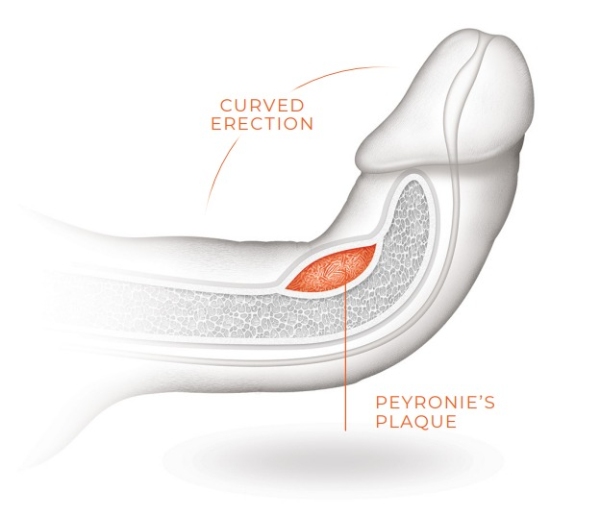
What is Peyronie’s disease?
Peyronie’s disease, sometimes shortened to PD, is a condition that causes scar tissue to form under the skin of the penis. This scar tissue is called a Peyronie’s plaque. When the penis becomes erect, the plaque can prevent the tissue from expanding evenly, causing the erection to bend or curve.
Peyronie’s disease is thought to involve a problem with the way the body heals after injury or repeated micro-injury. Instead of properly controlling scar formation, the body may build up too much collagen in one area over time.
Symptoms of Peyronie’s disease
Peyronie’s disease can affect appearance, comfort, intercourse, confidence, and erectile function. Symptoms may be mild, moderate, or severe.
Common symptoms
- A bent or curved erection, with or without pain
- A firm bump or plaque under the skin of the penis
- Pain during erections or sexual activity
- Penile shortening, narrowing, or indentation
- Difficulty with penetration or intercourse
- Erectile dysfunction or reduced confidence
Quality-of-life concerns
- Feeling bothered by erection appearance
- Worry about intercourse or sexual activity
- Avoiding intimacy due to pain or embarrassment
- Concern about progression of curvature
- Distress about sexual frequency or performance
- Relationship stress related to symptoms
What causes Peyronie’s disease?
The exact cause of Peyronie’s disease is not always known. In many cases, it may be related to injury or repeated microtrauma to the penis, followed by abnormal wound healing and scar tissue formation.
Penile injury can trigger scar formation
Injury may occur during sex, athletic activity, accidents, or other situations where the erect penis bends. Even small repeated injuries may contribute in some men.
Healing patterns may run in families
Men with family members who have Peyronie’s disease or related connective tissue conditions may be more likely to develop abnormal scarring.
Risk may increase with age
Older men may have less firm erections that bend more easily, which may increase the chance of injury or microtrauma.
Firmness and curvature can interact
Erectile dysfunction may make bending injury more likely, and Peyronie’s disease itself can also contribute to erectile difficulty.
Nonsurgical treatment option: XIAFLEX
XIAFLEX is a prescription medicine used to treat appropriate adult men with Peyronie’s disease who have a plaque that can be felt and a curve in the penis greater than 30 degrees when treatment is started.
XIAFLEX contains collagenase clostridium histolyticum. It is injected directly into the Peyronie’s plaque by a trained urology healthcare professional. The medication helps gradually break down collagen in the plaque, and treatment is paired with clinician and at-home modeling activities.
Adult men with palpable plaque
Your urologist must confirm that a Peyronie’s plaque can be felt and that the curve meets treatment criteria.
Greater than 30 degrees
XIAFLEX is used when the penile curve is greater than 30 degrees at the start of treatment.
Performed by a trained urologist
The injections are placed directly into the plaque during scheduled office visits.
Clinician and at-home role
XIAFLEX treatment is paired with gentle stretching and straightening activities as directed by your urologist.
Could you be a candidate?
You do not need to determine candidacy on your own. A urologist can evaluate the degree of curvature, whether a plaque can be felt, whether symptoms are stable, and whether XIAFLEX or another treatment option is appropriate.
Your urologist may assess
- Degree and direction of curvature
- Whether a Peyronie’s plaque can be felt
- Pain, erectile function, and sexual function impact
- Whether symptoms are stable or changing
- Medication use, including blood thinners
- Prior Peyronie’s disease treatments or procedures
XIAFLEX may not be appropriate if
- The plaque involves the urethra
- You are allergic to collagenase or ingredients in XIAFLEX
- Your curvature does not meet treatment criteria
- Your disease is not stable enough for treatment
- Risks outweigh expected benefit
- Another treatment option is more appropriate
How XIAFLEX treatment works
XIAFLEX treatment has two equally important parts: working with your treatment team during office visits and following your urologist’s at-home modeling instructions.
Working with your treatment team
XIAFLEX works to help gradually break down plaque over 1 to 4 treatment cycles, with about 6 weeks between each cycle.
Your role at home
For 6 weeks after each treatment cycle, you will perform gentle stretching and straightening activities as directed by your urologist.
First XIAFLEX injection
Your urologist injects XIAFLEX directly into the Peyronie’s plaque to help weaken and break it down.
1 to 3 days
You will follow your urologist’s instructions between appointments.
Second XIAFLEX injection
A second injection is placed into the plaque as part of the treatment cycle.
1 to 3 days
Your treatment team will tell you when to return for modeling.
Penile modeling visit
Your urologist performs a manual stretching and straightening procedure called penile modeling.
This completes 1 of up to 4 possible treatment cycles. You and your urologist will determine how many cycles are appropriate for you.
Select Important Safety Information
- The Peyronie’s plaque to be treated involves the tube that urine passes through, called the urethra.
- You are allergic to any collagenase or any of the ingredients in XIAFLEX.
Corporal rupture or penile fracture
XIAFLEX can cause serious side effects, including penile fracture or other serious injury to the penis. Damage may require surgery and may not fully improve.
Blood vessel injury
Blood vessels in the penis may break, causing blood to collect under the skin. In some cases, a procedure or surgery may be needed.
Hypersensitivity or anaphylaxis
Severe allergic reactions can happen because XIAFLEX contains foreign proteins. Symptoms can include hives, swollen face, breathing trouble, chest pain, low blood pressure, dizziness, or fainting.
Sudden severe back pain
Some patients may suddenly feel back pain after injection, including severe lower back pain that may move to the legs, feet, chest, or arms.
Syncope or near fainting
Fainting or near fainting can occur, especially if severe penile pain is present. Lie down if dizziness or faintness occurs.
Blood thinners and medical history
Tell your healthcare provider if you have a bleeding problem or take blood thinners, including prescription or over-the-counter medicines, vitamins, or supplements.
Symptoms that need urgent attention after XIAFLEX
Call your healthcare provider right away if you have symptoms of corporal rupture or serious injury to the penis, including:
- A popping sound or sensation in an erect penis
- Sudden loss of the ability to maintain an erection
- Pain in the penis
- Purple bruising and swelling of the penis
- Difficulty urinating or blood in the urine
After each XIAFLEX injection
Your penis may be wrapped with a bandage. Your urologist will tell you when to remove it. Bruising, swelling, and pain near the injection site are common after treatment.
- Avoid situations that strain abdominal muscles, such as straining during bowel movements.
- Do not use vacuum erection devices during XIAFLEX treatment.
- Follow all sexual activity restrictions given by your urologist.
Before receiving XIAFLEX
Tell your healthcare provider if you have had an allergic reaction to a previous XIAFLEX injection, have a bleeding problem, have received XIAFLEX for another condition, or have any other medical conditions.
Tell your healthcare provider about all medicines you take, including prescription medicines, over-the-counter medicines, vitamins, and herbal supplements. Using XIAFLEX with certain medicines can cause serious side effects. Especially tell your provider if you take anticoagulants or blood thinners.
Peyronie’s disease FAQ
What is Peyronie’s disease?
Peyronie’s disease is a condition where scar tissue, called plaque, forms under the skin of the penis. This plaque can cause a curve or bend during erection.
Does Peyronie’s disease always hurt?
Not always. Some men have pain, especially earlier in the condition, while others mainly notice curvature, plaque, shortening, indentation, or sexual function changes.
Can Peyronie’s disease affect sex?
Yes. Peyronie’s disease may make intercourse difficult or uncomfortable, affect confidence, reduce sexual frequency, or contribute to erectile dysfunction.
What is XIAFLEX?
XIAFLEX is a prescription injection used to treat appropriate adult men with Peyronie’s disease who have a palpable plaque and curvature greater than 30 degrees at the start of treatment.
How long does XIAFLEX treatment take?
XIAFLEX may involve 1 to 4 treatment cycles, with approximately 6 weeks between cycles. Each cycle includes office visits and at-home modeling activities as directed by the urologist.
Can I have sex during XIAFLEX treatment?
Do not have sex or engage in sexual activity between the first and second injections of a treatment cycle. Do not have sex or other sexual activity for at least 4 weeks after the second injection and after any pain and swelling have gone away.
Is XIAFLEX safe for everyone with Peyronie’s disease?
No. XIAFLEX is not appropriate for every patient. A urologist must evaluate your plaque, curvature, medical history, medication use, and risk factors before recommending treatment.
Medical references
This page is educational and does not replace medical advice, diagnosis, or treatment from a qualified physician. These references support the medical information above:
Get answers about curvature, plaque, and treatment options.
Health Orlando Urology provides discreet Peyronie’s disease evaluation and treatment planning for men in Kissimmee, Orlando, and Central Florida.